

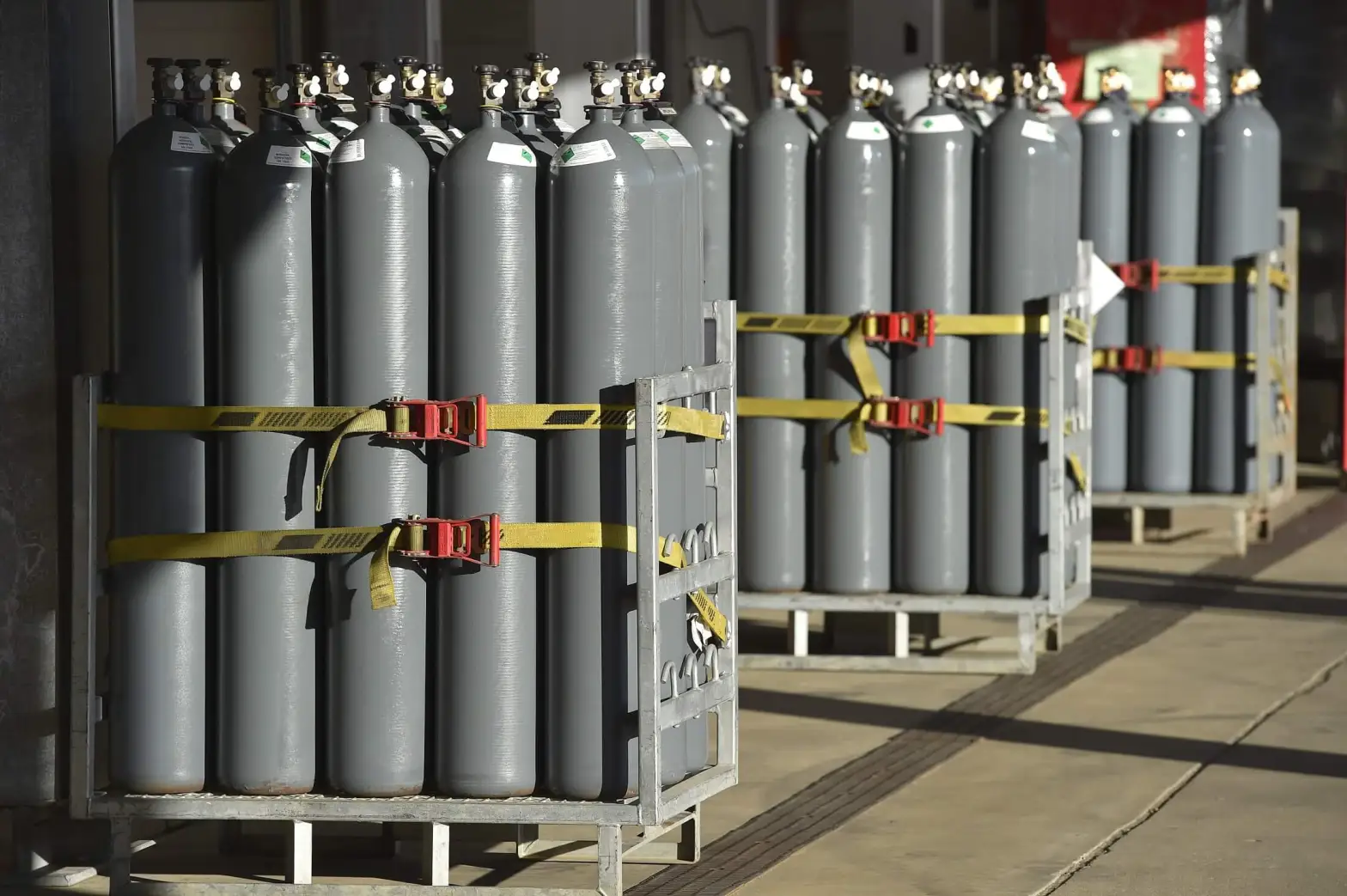
The majority of cylinder incidents shouldn’t happen. They don’t come from a catastrophic failure. Most come from a sheared valve after a cylinder tips over, a mismatched regulator forced onto the wrong gas, or someone testing a connection with a lighter instead of soapy water. The equipment does its job and is generally safe when used correctly or maintained properly. These failures happen in the gaps – the missing cap, the skipped inspection, the cylinder stored on its side because there wasn’t time to chain it up.
Storage position and restraint
Store cylinders upright and secure them to a wall, post, or rack using a chain or strap. Never lean them against a bench. They should not be left lying on their sides “just for now.” A tipped cylinder that impacts something can shear its valve, and a sheared valve on a full high-pressure cylinder turns the cylinder into an unguided projectile. This is as dramatic as it sounds – and also quite possibly one of the only gas handling failures that can kill someone who isn’t even touching the equipment.
Storage areas must also be dry and well-ventilated, away from radiators, direct sun, and any spark-producing source. Heat increases internal pressure, while poor ventilation allows any small leak to accumulate versus disperse. Neither condition has to be extreme to cause a problem over weeks or months of use.
Inspect before you connect
Before you connect anything, inspect the cylinder. If it has dents, corrosion, bulges, or heat marks, it’s better to be safe than sorry and not use it. A cylinder with any of these issues should also be tagged so it doesn’t accidentally end up in rotation later on. If the cylinder has been dropped, or subjected to a house fire, even if it seems fine, you should probably assume it’s unsafe to use at normal rated pressure.
Make sure to also check the hydrostatic test date. All cylinders are re-test items, and if it’s overdue for testing, that means nobody with the right knowledge and tools has certified that it’s safe to use under pressure.
This is also a good time to make sure your regulator is in good condition. If it doesn’t match the gas type, or the CGA for that gas, that’s a self-explanatory no-go. The pressure rating on the regulator should also be higher than the cylinder – not just close to the mark – to ensure it doesn’t fail under its usual operating pressure. If you need to replace your regulator, a large quality range of certified regulators are available On engweld.co.uk to make sure you have the proper matches for your gas and gas-line.
Connect, open, and test properly
Once you have the regulator on and the fitting secured, start to open the cylinder valve and do that slowly, but while you do that, if possible, stand to the side rather than directly in front of the gauge face. A fast open on a high-pressure line can throw a spike into the regulator and really damage those internals.
After you open, check every joint with soapy water. If you see bubbles, you’ve got a leak. This isn’t optional. This isn’t a step you can skip because the last ten connections were fine. Don’t check with a flame; that’s how flashback incidents happen, and that’s exactly what a flashback arrestor is there to guard against on a flammable gas line. If you smell or see gas on your leak detector and you can’t immediately identify the source, close the valve, clear the area, and don’t try to troubleshoot it live.
Keep flammables and oxidizers apart
It is essential to store Oxygen and other oxidizing gases far away from flammable gases such as acetylene, propane, and hydrogen. The commonly accepted guideline is to have at least 20 feet of separation or a noncombustible barrier at least 5 feet high with a fire rating of 30 minutes. The rules of separation are straightforward because a leak from either side is manageable while a flammable leak is a minor issue until it is next to an oxidizer and turns into a fire that spreads quickly and burns hot.
Design your storage layout with this in mind, starting from a clean sheet. Retrofitting a barrier after a near-miss is a much harder conversation than separating it as part of your floor plan before you ever add a cylinder rack.
Protect the valve, always
The cylinder valve is the most vulnerable point on the whole unit. It’s a precision-machined component sticking out of a vessel holding gas at high pressure, and it’s not designed to take impact. The valve protection cap exists for exactly this reason, and it should stay on any time the cylinder isn’t actively connected to a regulator.
Never lift or drag a cylinder by its cap or valve. It’s not a handle – it’s a safety device with limited structural strength. Use a proper hand truck or trolley designed for cylinder transport, and roll or wheel cylinders rather than dragging them across a floor.
Don’t fix it yourself
If you have a regulator that sticks, a valve that doesn’t seem to seat properly, or a cylinder that appears to be damaged, the correct response is not a wrench and a positive attitude. It’s a return to the supplier or a qualified technician. Regulators are mechanical devices. They contain internal springs and diaphragms that are carefully calibrated to specific tolerances – a repair you did in your garage might look fine but could easily fail a few weeks down the line under pressure.
You should keep full and empty cylinders in separate, clearly labeled areas as well. Running out of a “full” cylinder halfway through a job is an annoyance. The alternative – assuming a cylinder is empty and treating it carelessly – is a disaster.
None of this is rocket science. It’s just a sequence. But you have to follow it every time without exception. The cylinders that cause problems are almost never the ones that failed randomly. They’re the ones where someone skipped the cap, skipped the inspection, or made do with the nearest available regulator rather than the one designed for the gas in question.
