

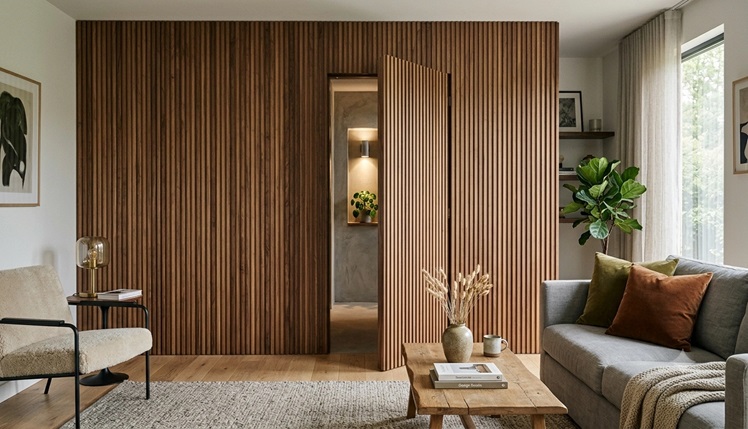
Modern interior design puts emphasis on creating simple lines without breaks and the original use of space. Using hidden doors and storage allows you to keep all functional zones invisible and make the wall appear as if it continues. It is possible to achieve perfect results in blending these elements using proper laminates.
The laminated concealed door can be camouflaged as part of the wall and made practically invisible when closed. The same suggestions can be applied to other storage units, utility and working areas, etc.
Creating Seamless Walls with Hidden Doors
The main goal of the hidden door idea is to create an impression that the door is part of the wall. It is necessary to align the surface of the door with the panels, joints, and hardware.
A hidden door within a seamless wall panel should use a finish that continues visually across both the wall and door. Selecting coordinated wall laminates can help maintain the same colour, texture, and pattern direction so that the opening becomes less noticeable when it is closed.
Choosing Laminates for Concealed Doors
Choosing the right laminate is critical because concealed doors depend on visual continuity as much as precise installation. When adapting laminate door designs for a hidden-door concept, plain colours can create a flat uninterrupted plane, while woodgrain or textured finishes need careful pattern alignment across the wall and door
When laminates have patterns, care should be taken regarding the pattern’s direction and placement. If the pattern continues from the wall onto the door, it appears to smooth the transition.
In the case when the internal surfaces have aesthetic finishing already applied, concealing a door with the help of furniture, floors, and this wall would create the needed coherence. The collection of decorative laminates offered by Royale Touche could be used to achieve the required aesthetics.
Designing a Jib Door for Modern Interiors
A jib door design is the one one would want to implement if one needs to make the entrance pilferproof. The door can be included in a wall, bookshelf, panel, etc.
For instance, the concealed door can be placed in an accent wall, revealing a closet or utility room, or the door can be used to access a closet so that the wall design around it is not interrupted. The doorway does not need to be completely concealed. The intention is to lessen any visual disturbance, while allowing easy access.
Managing Hidden Storage Using Laminate Panelling
Hidden storage space could come in handy in places where people wish to keep things looking neat and orderly. Cabinets can be put away behind panels, in furniture, or next to hidden doors.
Hidden storage laminate panelling can make it easy to merge these practical parts with the overall design of the room. The laminate can go across the cabinet shutters and panels, thus making the storage blend into the environment.
Such items as books, appliances, other supplies, or documents can be kept in secret compartments depending on the needs of users.
Selection of Hardware and Installation
A concealed door implies more than just a perfectly laminated finish. It requires attention to the hinges, mechanism of opening, thickness, door frame, and walls surrounding the door during the process of planning.
The hardware needs to be selected according to the size and weight of the door. The installation must ensure easy opening of the door without harming any of the surfaces.
All the edges and joints should be properly treated since they may impact either the look or the performance. A professional approach and precise installation guarantee that the hidden door will look as it is supposed to.
Conclusion
Hidden doors and concealed storage can help create clearer interiors. Concealed laminated doors can look as part of the wall, while designed panels will create a smooth storage space.
Irrespective of a chosen door type — whether it is a seamless door, a jib door, or hidden storage laminated wood—each project needs to pay attention to the laminate design, wall design, hardware, and installation.